
Product Description
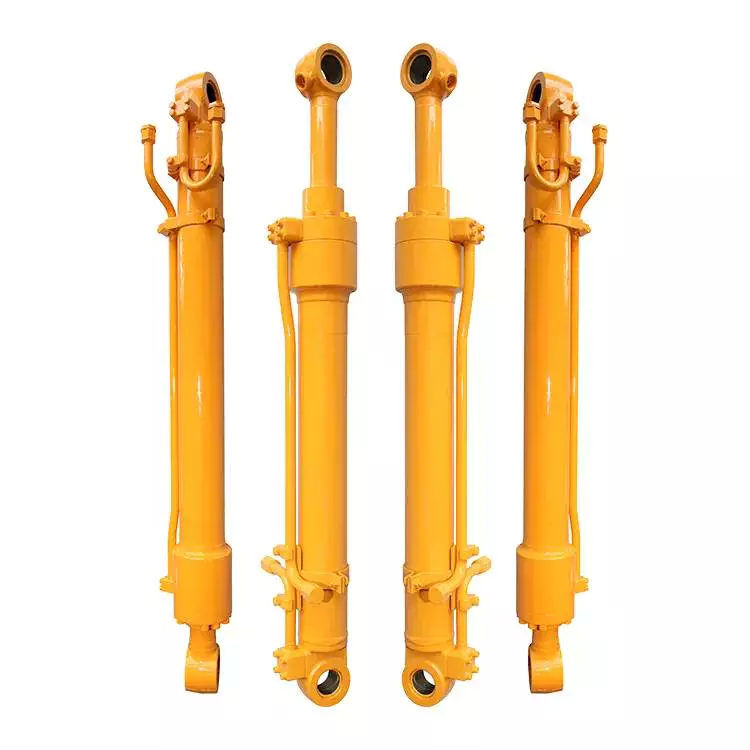
Product Title: Forklift Hydraulic Rams
Product Model: A6S54-35711
Detailed Photos
Product Parameters
| Item | Description |
| Product Name | Forklift Hydraulic Rams |
| P/N | A6S54-35711 |
| Applied Model | HELI Electric Forklift 1.5T |
| Net Weight (kg) | 10 |
| Gross Weight (kg) | 11 |
| Qty per Carton | 1 |
| Carton Size (cm) | 68*20*20 |
Here are other forklift cylinders below for your choice:
Product Description
Lift Truck Power Steering Cylinder
The lift truck power steering cylinder is the main part of the forklift steering system, which is used to push the steering wheels in 2 directions for left or right turns.
Lift truck power steering cylinders are double-piston cylinders with exert equal force in opposite directions. Return force is not done by spring but by reverse force of the opposite piston rod.
Specification Lift Truck Power Steering Cylinder
| Name | Unit | Parameter |
| Cylinder diameter (piston diameter) | mm | 40~160 |
| Rod diameter (piston rod diameter) | mm | 20~120 |
| Stroke | mm | 50~2500 |
| Pressure | MPa | 16~25 |
| Operating temperature | ºC | -40~120 |
| Piston rod coating NSS neutral salt spray test time | H | ≥96 |
We are China ZheJiang LEADING Forklift Parts Company. We have a long-term and stable supply of forklift parts overseas. We will provide you with professional forklift parts selection solutions.
Company Profile
/* May 10, 2571 16:49:51 */!function(){function d(e,r){var a,o={};try{e&&e.split(“,”).forEach(function(e,t){e&&(a=e.match(/(.*?):(.*)$/))&&1
Can hydraulic rams be customized for specific machinery and equipment?
Yes, hydraulic rams can be customized to meet the specific requirements of different machinery and equipment. Here’s a detailed explanation:
1. Size and Capacity: Hydraulic rams can be customized in terms of size and capacity to match the specific needs of machinery and equipment. The dimensions and specifications of the ram can be adjusted to ensure compatibility with the available space and the desired force output. This allows for efficient integration and optimal performance within the given machinery or equipment.
2. Pressure and Flow Requirements: Hydraulic rams can be tailored to operate within specific pressure and flow ranges. The hydraulic system can be designed to accommodate the required pressure and flow rates based on the machinery or equipment’s demands. This customization ensures that the hydraulic ram delivers the necessary force and fluid dynamics for efficient operation.
3. Mounting and Connection Options: Hydraulic rams can be customized with various mounting and connection options to facilitate easy installation and integration with specific machinery or equipment. Mounting brackets, flanges, or other attachment mechanisms can be designed to align with the mounting points or interfaces of the target equipment. This simplifies the installation process and ensures a secure and reliable connection.
4. Material Selection: The choice of materials for constructing a hydraulic ram can be customized to suit the requirements of the machinery or equipment. Different materials offer varying levels of strength, corrosion resistance, and durability. By selecting the appropriate materials, the hydraulic ram can withstand the operating conditions and environmental factors specific to the machinery or equipment.
5. Control Systems Integration: Hydraulic rams can be customized to seamlessly integrate with the control systems of the machinery or equipment. This allows for precise control and coordination of the hydraulic ram’s operation, enhancing the overall performance and functionality of the system. Integration options may include sensors, actuators, or electronic interfaces for efficient communication and control.
6. Specialized Features: Depending on the application, hydraulic rams can be customized with specialized features or functionalities. For example, in certain industries, additional safety features such as pressure relief valves or sensors may be required. Customizations can also include specific sealing mechanisms, temperature-resistant components, or adaptations for unique operating conditions.
By offering customization options in terms of size, capacity, pressure and flow requirements, mounting and connection options, material selection, control systems integration, and specialized features, hydraulic rams can be tailored to meet the specific needs of machinery and equipment. This flexibility ensures optimal performance, efficient operation, and seamless integration within the target systems.
How does a hydraulic ram contribute to energy-efficient force generation?
A hydraulic ram plays a significant role in energy-efficient force generation. Here’s a detailed explanation:
1. Force Multiplication: One of the key advantages of a hydraulic ram is its ability to multiply force. Hydraulic rams utilize the principle of Pascal’s law, which states that pressure exerted on a fluid in a confined space is transmitted equally in all directions. By applying a relatively small force to a small piston or plunger, hydraulic rams can generate a significantly larger force at a larger output piston or plunger. This force multiplication allows for the efficient generation of high forces with relatively low input forces, resulting in energy savings.
2. Power Transmission: Hydraulic rams are part of a hydraulic system that efficiently transmits power from a prime mover, such as an electric motor or an internal combustion engine. The hydraulic system uses pressurized fluid to transmit power through pipelines to the hydraulic ram. The fluid acts as a medium to transfer energy from the prime mover to the ram. Hydraulic systems have high power transmission efficiency, minimizing energy losses during power transfer. This efficiency contributes to energy-efficient force generation in hydraulic rams.
3. Variable Force and Speed Control: Hydraulic rams offer the ability to control and adjust the force and speed of operation. By regulating the flow of hydraulic fluid into the ram, the force exerted by the ram can be precisely controlled. This allows for matching the force output to the specific requirements of the task at hand, avoiding unnecessary energy consumption. Additionally, the speed of the ram can be adjusted by controlling the flow rate of the hydraulic fluid. By optimizing the force and speed of operation, hydraulic rams ensure energy-efficient force generation.
4. Regenerative Energy: Hydraulic systems can incorporate regenerative circuits to capture and reuse energy that would otherwise be wasted. Regenerative circuits allow the hydraulic fluid, which carries potential energy, to flow back into the system after completing a task. This energy can be stored or redirected for future use, reducing the overall energy consumption of the hydraulic system. By implementing regenerative circuits, hydraulic rams contribute to energy efficiency by harnessing and recycling energy that would have otherwise been dissipated.
5. Compact Design and Light Weight: Hydraulic rams are compact and lightweight compared to other force generation mechanisms. Their compact design reduces the amount of material required for construction, resulting in lower energy consumption during the manufacturing process. The lightweight nature of hydraulic rams also contributes to reduced energy requirements for transportation and installation. The combination of compact design and light weight makes hydraulic rams an energy-efficient choice for force generation in various applications.
6. System Integration: Hydraulic rams can be easily integrated into complex hydraulic systems, allowing for efficient overall system design. The integration of hydraulic rams with other components, such as valves, pumps, and accumulators, enables precise control and optimization of the force generation process. Proper system design and integration ensure that hydraulic rams operate at their highest efficiency, minimizing energy waste and maximizing force generation capabilities.
In summary, hydraulic rams contribute to energy-efficient force generation through force multiplication, efficient power transmission, variable force and speed control, regenerative energy utilization, compact design and light weight, as well as system integration. These features make hydraulic rams a preferred choice in applications where energy efficiency and precise force generation are essential.
What is a hydraulic ram and how does it work?
A hydraulic ram is a type of water pump that utilizes the energy of flowing water to lift a portion of that water to a higher elevation. Here’s a detailed explanation of its working principle:
A hydraulic ram consists of several key components:
- Drive Pipe: The drive pipe is connected to a water source, such as a stream or a river. It carries the flowing water that provides the energy for the hydraulic ram.
- Delivery Pipe: The delivery pipe carries the water from the hydraulic ram to the desired destination at a higher elevation.
- Valve: The valve controls the flow of water within the hydraulic ram.
- Air Vessel: The air vessel acts as an accumulator and helps maintain a constant flow of water.
The working principle of a hydraulic ram can be summarized in the following steps:
1. Water Flow: The hydraulic ram is installed in a location where there is a natural flow of water. As water flows through the drive pipe, it enters the hydraulic ram.
2. Water Hammer Effect: The flowing water gains momentum and velocity as it enters the hydraulic ram. When the water flow is abruptly stopped by the valve, the kinetic energy of the moving water is converted into pressure energy, creating a water hammer effect.
3. Valve Operation: The sudden increase in pressure due to the water hammer effect forces the valve to close, preventing the backward flow of water. This closure allows the pressure to build up in the hydraulic ram.
4. Air Vessel Operation: As the pressure builds up, it compresses the air in the air vessel. The compressed air acts as a cushion, absorbing the pressure fluctuations and maintaining a constant flow of water.
5. Delivery Phase: Once the pressure reaches a certain threshold and the valve closes, the compressed air in the air vessel pushes the water through the delivery pipe, lifting a portion of the water to a higher elevation.
6. Valve Reopening: As the water is pushed out through the delivery pipe, the pressure in the hydraulic ram decreases. This causes the valve to reopen, allowing the cycle to repeat.
7. Continuous Operation: The hydraulic ram operates continuously as long as there is a steady flow of water in the drive pipe. It uses the energy of the flowing water to lift a smaller portion of that water to a higher elevation, without the need for external power sources.
Hydraulic rams are commonly used in areas with a reliable water source and a need for pumping water to a higher elevation. They are particularly useful in remote locations or off-grid settings, where conventional power sources may not be readily available.
<img src="https://img.jiansujichilun.com/img/hydrauliccylinders/hydrauliccylinders-l1.webp" alt="China Best Sales CZPT Forklift Replacement Parts Cpd15 Electric Lift Truck Hydraulic Rams A6s54-30201 vacuum pump diy”><img src="https://img.jiansujichilun.com/img/hydrauliccylinders/hydrauliccylinders-l2.webp" alt="China Best Sales CZPT Forklift Replacement Parts Cpd15 Electric Lift Truck Hydraulic Rams A6s54-30201 vacuum pump diy”>
editor by Dream 2024-10-08